

July 16, 2025 – San Diego, CA – San Diego Foundation (SDF) and San Diego Association of Governments (SANDAG) today announced 10 affordable housing projects across San Diego County will receive $14 million in total funding from California’s Regional Early Action Planning (REAP) program, referred to as REAP 2.0, helping to bring 966 much-needed affordable housing units to the region. The units will enter the market between December 2026 and June 2030, with 660 units becoming available as soon as 2027.
“California is facing an affordability crisis that touches every community across our state,” said Jim Howell, Chief Financial Officer, San Diego Foundation. “In San Diego, we’re seeing our teachers, nurses, firefighters and essential workers—the very people who ensure our neighborhoods remain safe and vibrant—face enormous challenges in finding affordable housing. The REAP 2.0 funding allows us to accelerate innovative housing solutions to address our region’s most pressing housing needs while advancing our climate commitments.”
Since 2020, San Diego County’s home prices have skyrocketed 42%, with more than one in three San Diegans spending more than 30% of their income on housing. According to the San Diego Housing Federation, San Diego County needs to create 134,500 more affordable housing units to address the growing need for low-income rentals.
REAP 2.0 is a flexible statewide program created to accelerate progress toward California’s housing goals and climate commitments through strengthened partnerships between the state, its regions and local entities. The program supports the development of affordable housing while advancing climate and equity objectives.
REAP 2.0 funding enabled SANDAG to expand its focus to support the region’s housing crisis and climate goals. In addition to the commitment to the Regional Housing Trust Fund administered through San Diego Foundation, SANDAG has also suballocated $12.3 million to local jurisdictions for planning and capital investments, and $4.4 million to the Southern California Tribal Chairmen’s Association to help tribes meet their unique housing needs. Other REAP 2.0 highlights include a partnership with transit agencies to support activities that advance affordable housing and redevelopment at transit hubs and a technical assistance program for the local jurisdictions.
“This partnership between SANDAG and San Diego Foundation will facilitate much-needed housing solutions across our region,” said SANDAG Chair and Solana Beach Mayor Lesa Heebner. “This funding, provided by the State of California, will give individuals and families more opportunities to find affordable places to live and build their futures, while helping meet regional and state housing goals.”
SANDAG selected SDF to administer a regional housing trust fund and distribute REAP 2.0 funding to increase affordable housing development and climate goals across the region. As the region’s community foundation, SDF has extensive experience mobilizing public/private partnerships, leading competitive award processes and deploying innovative capital strategies to support housing initiatives throughout San Diego County.
SDF’s committee of experts conducted a competitive bid process utilizing a comprehensive scoring and evaluation system to select qualifying developers with shovel-ready multi-family projects serving lower- and moderate-income households in San Diego. After analyzing 24 applications, SDF today unveiled 10 local projects selected through a multi-stage review process to receive six grants totaling $8 million and four low-interest loans totaling $6 million.
“This grant award represents more than financial support—it is a commitment to climate justice, community empowerment and equitable development at the border,” said Lisa Cuestas, CEO of Casa Familiar, one of the selected projects to receive REAP 2.0 funding. “With these funds, Casa Familiar and the Avanzando San Ysidro Community Land Trust will advance a bold, resident-led vision that centers affordable housing, environmental resilience and long-term community ownership in one of San Diego’s most under-resourced neighborhoods. Together, we are not just building housing—we are building a just, climate-resilient future for San Ysidro.”
The total impact of the REAP 2.0 funding will help to create 966 affordable, climate resilient housing units across San Diego County serving low- to middle-income veterans, seniors, refugees/immigrants, individuals, families and single women in need.
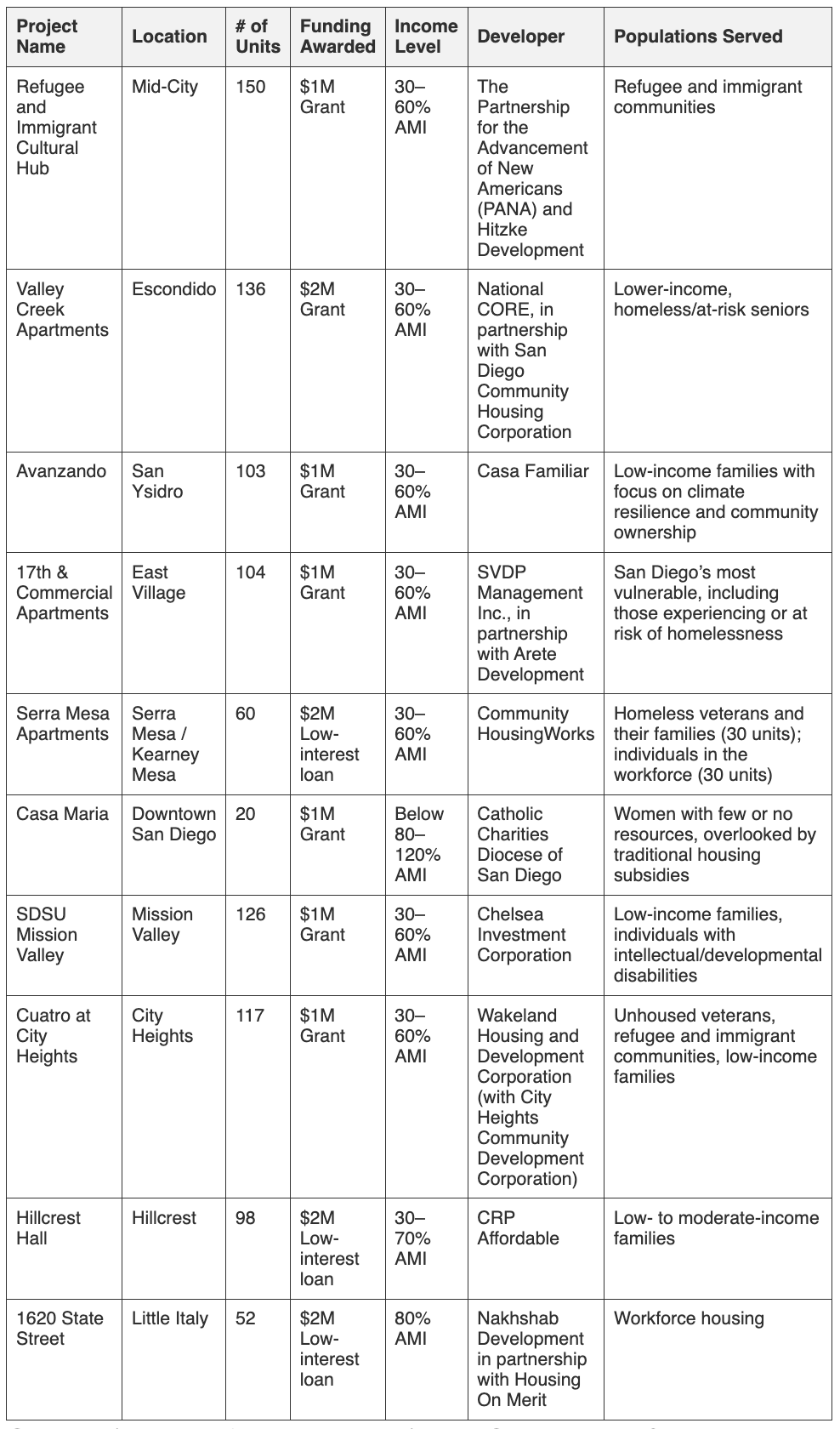
The following ten awarded projects are also featured with additional details, maps and renderings on the SDF website:
Today’s announcement of the REAP 2.0 funding recipients builds upon San Diego Foundation’s commitment to create innovative housing solutions, including the launch of the San Diego Housing Fund in 2022. San Diego Housing Fund partners with investors, developers and property owners to provide low-cost capital with a goal of producing 1,000 new homes annually for the next decade. SDHF is currently mobilizing approximately $1 billion in new construction across the region to build medium-density infill that creates workforce housing without relying solely on tax credits.
(See detailed project descriptions on the following pages and on SDF’s website)
REAP 2.0 Awarded Projects
About San Diego Foundation
San Diego Foundation believes in just, equitable and resilient communities where every San Diegan can prosper, thrive, and feel like they belong. We partner with donors, nonprofits and regional leaders to co-create solutions that respond to community needs and strengthen San Diego. Since our founding in 1975, our community foundation has granted $1.8 billion to nonprofits to improve quality of life in San Diego County and beyond. Join us in commemorating 50 years of impact – and looking toward the next 50 – by learning more at SDFoundation.org.
About SANDAG
SANDAG is the regional agency that connects people, places and innovative ideas by implementing solutions with our unique and diverse communities. We are committed to creating a San Diego region where every person who visits, works and lives can thrive. Learn more at SANDAG.org.
Media Contact: Nancy Ives Schroeder | 619-540-3751| nancy@intesacom.com
Global Village: Refugee and Immigrant Cultural Hub & Housing Campus (Mid-City San Diego) – 150 units | Income Level: 30-60% Area Median Income (AMI) | $1M Grant
- Developer: The Partnership for the Advancement of New Americans (PANA) with Hitzke Development Corp and other partners
Populations Served: Mid City community; refugee and immigrant families - Features: 150+ large-sized affordable homes, co-located affordable housing with spaces for arts, culture, childcare, entrepreneurial and workforce development, and community wellness, 50,000 square feet of integrated programming space designed as an integrated model for belonging, equity, resilience, 100% community-owned and designed to deliver far more than housing
- Partners: 17 community-based organizations; developed with input from more than 2,000 San Diegans with refugee and immigrant communities leading the process. Designed to be 100% community owned. Exceptional team of partners with proven experience in affordable housing, equitable development and award-winning design
- Community Benefits: Addresses decades of unmet needs in one of San Diego’s most disinvested urban areas. Reimagines belonging and home while meeting the social, cultural and wellness needs of families. Located near future climate-resilient infrastructure including Chollas Triangle Park, University Ave Bikeway and Rapid 625
Valley Creek Apartments (Escondido) – 136 units | Income Level: 30-60% AMI | $2M Low-interest loan
- Developer: National CORE, in partnership with San Diego Community Housing Corporation
- Population Served: Lower-income, homeless/at-risk senior veterans
- Service Providers: Hope Through Housing Foundation leads on-site resident service coordination with West PACE, San Diego PACE, Meals on Wheels, San Diego Food Bank and Produce Good
- Features: 100% affordable senior community with 14 units designated as permanent supportive housing for veterans. Project features sustainable and community-focused design, including substantial onsite solar power generation, energy-efficient systems and integration with the adjacent Escondido Creek Trail
Community Benefits: Workforce development opportunities, job creation and economic impact driven by strategic partnerships and on-site older adult services
Avanzando (San Ysidro) – 103 units | Income Level: 30-60% AMI | $1M Grant
- Developer: Casa Familiar
- Population: Low-income families with focus on climate resilience and community ownership
- Service Provider: La Semilla Community Resiliency Center provides over 7,000 sq. ft. of wrap-around services, including workforce and youth development programs, digital literacy, health workshops and civic engagement
- Features: Project features the Avanzando San Ysidro Community Land Trust, which guarantees permanent community ownership, preventing displacement and preserving affordability for future generations. Includes an all-electric design with rooftop solar, drought-tolerant landscaping, advanced cooling systems
- Community Benefits: Project sets a regional model for equitable development that integrates housing, environment and social equity. Emergency preparedness, workforce development, digital literacy programs, cultural programming, free 3-year transit passes and electric micro-mobility
17th & Commercial (East Village) – 104 units | Income Level: 30-60% AMI | $1M Low-interest loan
- Developer: Father Joe’s Villages, SVDP Management, Inc., Arete Development
- Population: San Diego’s most vulnerable, including those experiencing or at risk of homelessness
Service Provider: Father Joe’s Villages - Features: Onsite services include wraparound case management, behavioral health support, health navigation, housing retention assistance and employment readiness. Building amenities include rooftop terraces, indoor lounges and bike storage; deeply affordable units incorporate universal design principles, with 15% mobility-accessible and 10% communication-accessible homes. Development targets LEED Silver certification, with integrated solar, bioswales, water-conservation measures and zero on-site parking to encourage sustainable living. Each unit is protected by long-term affordability covenants (55+ years), regulatory agreements and a financing stack designed to keep rents low
- Community Benefits: Units are strategically located within a Mobility Hub and Transit Priority Area that ensures walkable access to healthcare, jobs, education and regional transit. The intentional siting dismantles barriers to opportunity and supports economic mobility
Serra Mesa Apartments (Serra Mesa/Kearny Mesa) – 60 units | Income Level: 30-60% AMI | $2M Low-interest loan
- Developer: Community HousingWorks (CHW)
- Population Served: Individuals and families, formerly homeless veterans and their families
Service Providers: U.S. Department of Veterans Affairs (VA) and CHW’s Achieve Resident Services program (financial coaching, youth and adult education, career development programming, etc.) - Key Features: Apartments are energy efficient and sustainable housing located in a Transit Priority Area close to the VA’s Kearny Mesa campus and built on surplus public land in high-opportunity neighborhood, which is part of Mayor Todd Gloria’s Homes for All of Us initiative.
- Community Benefits: Onsite offerings include HUD-VA Supportive Housing (HUD-VASH) program, case management, resident services area, computer lab, laundry facilities, bike parking
Casa Maria (Downtown/Gaslamp District) – 20 units | Income Level: Below 80-120% AMI | $1M Grant
- Developer: Catholic Charities Diocese of San Diego
- Population Served: Single women with few or no resources who have been overlooked by traditional housing subsidies
- Key Features: An exemplary pilot project showcasing how a nonprofit organization and faith-based entity are coming together to transform Casa Maria, a single transitional home, into a 20-unit, two-story affordable housing development for women in need. Offers critically needed self-help programs and creates a supportive environment for women to safely gather and continue self-improvement efforts, while addressing the root causes of homelessness. Located in a Transit Priority Area, where public transportation is readily available and is approximately five miles from two identified Mobility Hubs to enhance workforce accessibility.
- Community Benefits: Transit-oriented project reflects a transitional home that helps single women earning well below 80% AMI. The project is a community-first model, featuring unique, low-cost building design intended to be replicated throughout the region
SDSU Mission Valley – 126 units | Income Level: 30-60% AMI | $1M Grant
- Developer: Chelsea Investment Corporation
- Population Served: Low-income families, individuals with intellectual/developmental disabilities
Service Provider: Pacific Southwest Community Development Corporation (PSCDC) will provide on-site services at no charge to the residents of SDSU Mission Valley. PSCDC will provide adult education and offer an after-school program that includes tutoring, mentoring, arts & crafts and other educational enrichment activities - Key Features: Sustainable housing development is part of the master plan, which includes an 80-acre mixed-use campus with 4,600 multi-family homes, Snapdragon Stadium, 34-acre River Park, LEED GOLD certification and MTS Green Line Trolley access
- Community Benefits: Adult education and comprehensive after-school programs with tutoring/mentoring, specialized services offered through San Diego Regional Center partnership
Cuatro at City Heights – 117 units | Income Level: 30-60% AMI | $1M Grant
- Developer: Wakeland Housing and Development Corporation (with City Heights Community Development Corporation)
- Population Served: Unhoused veterans, refugee and immigrant communities, low-income families
- Key Features: A transformative mixed-use affordable housing development that will create 117 new affordable homes across four scattered building sites, primarily serving large families, with 30 units specifically reserved for unhoused veterans. Cuatro represents more than new housing—it’s a community revitalization effort that will bring new purpose to properties that have remained vacant and underutilized for decades. Each building features 21 to 38 residential units with modern amenities including bicycle parking, laundry facilities and outdoor courtyards
- Community Benefits: 30 units with Interfaith Community Services case management for veterans, 708 hours annual support coordination, financial literacy training, job readiness workshops, mental health assistance, Energy Star appliances, bicycle infrastructure
Hillcrest Hall – 98 units | Income Level: 30-70% AMI | $2M Low-interest loan
- Developer: CRP Affordable
- Population Served: Low- to moderate-income families
- Service Provider: Life Skills Training and Educational Programs, Inc. (LifeSTEPS) will offer adult education classes, and health and wellness services
- Key Features: Envisioned as a sustainable, high-density mixed-use development, private balconies, rooftop patio, picnic area and playground
Community Benefits: Features on-site offices for supportive services, community room, on-site management, computer room, holistic people-centered approach
1620 Street (Little Italy) – 52 units | Income Level: 80% AMI | $2M Low-interest loan
- Developer: Nakhshab Development, in partnership with Housing On Merit, a general managing partner to oversee the regulatory agreement and property management
- Population Served: Workforce housing for employees in Little Italy’s restaurant/hospitality corridor
- Key Features: Sustainable, mixed-use development including water conservation, energy efficient equipment/appliances with large, open spaces with natural light and passive ventilation. Includes ground-floor retail spaces designed for small business incubation at manageable sizes/rates, water conservation and energy-efficient systems
- Community Benefits: Small business incubation is offered at the affordable housing project through flexible lease arrangements and revenue-sharing. By creating workforce housing in Little Italy, Nakhshab hopes to create a community where people can live and work rather than commuting to more remote sections of San Diego