
The 2025 Giving Season presents a unique opportunity to strengthen the place we call home. Many San Diegans like you increase your giving during the holidays. And this year, there’s an added reason to act.
New charitable tax rules tied to the federal “One Big Beautiful Bill” are scheduled to start on January 1, 2026. That makes the rest of 2025 a “Giving Window” to support local nonprofits and initiatives while maximizing tax benefits under the current law.
Whether you choose to align your giving with important initiatives like United for San Diego, Fifty & Forward, or another cause close to you, timing matters.
With that in mind, here are seven tax-smart charitable tips to close out the year. As always, our Giving Team is available to assist you at (619) 814-1332 or [email protected].
1. Give Cash
Giving cash, usually in the form of a check or wire transfer, to a nonprofit organization or your donor-advised fund (DAF) enables you to claim a tax deduction of up to 60% of your adjusted gross income (AGI) in any one year when you itemize tax deductions. You can carry forward contributions exceeding that limit for up to five subsequent tax years.
Or consider setting up a recurring monthly gift to support programs at a smaller level throughout the year. You can change or cancel any time.
Double Your Online Gift by December 31
2. Donate Appreciated Securities
Direct gifts of long-term, appreciated securities, including publicly traded stock, publicly traded bonds and mutual fund shares, to a nonprofit or your DAF offer important advantages.
The full fair market value of your gift is deductible as a charitable contribution up to 30% of your AGI each year when you itemize deductions. You can carry forward contributions exceeding that limit for up to five subsequent tax years.
Also, you eliminate the capital gains tax you would incur if you sold the assets and donated the after-tax proceeds, which could increase the amount available to donate by up to 20%.
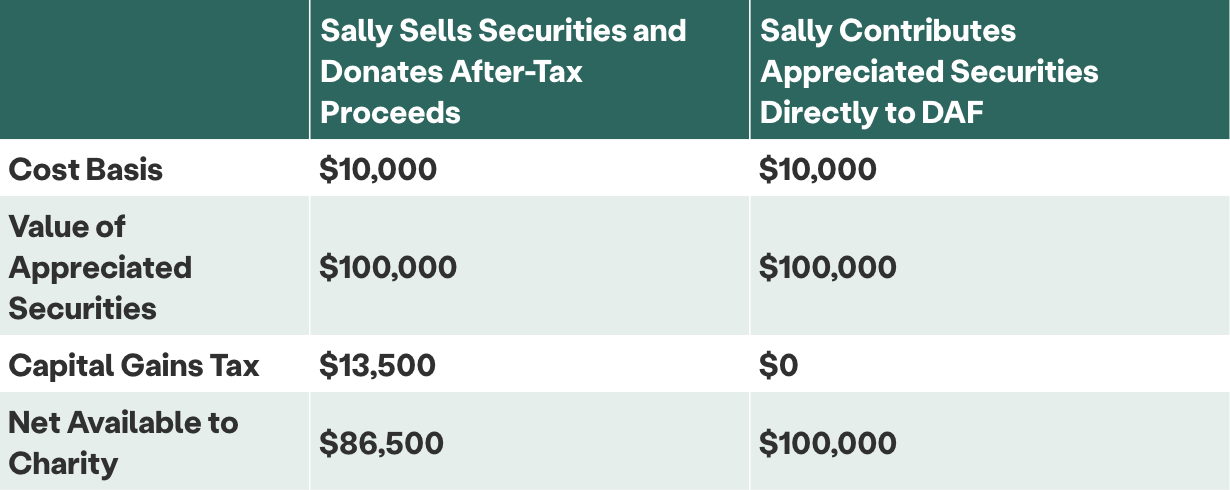
In the example below, “Sally” has $100,000 in long-term appreciated stock, with a $10,000 cost basis.
Assuming a 35% income tax rate and a 15% long-term capital gains rate, the DAF allows Sally to avoid tax on her $90,000 gain and give more to charity ($13,500).
Conversely, if you decide to sell depreciated securities at a loss, you may choose to donate cash from the sale of those securities and claim a tax deduction of up to 60% of your AGI from your cash donation.
3. “Bunch” Gifts in 2025
Bunching means concentrating two or more years of charitable gifts into a single tax year so that your total itemized deductions exceed the standard deduction that year. In the following year(s), you take the standard deduction again. The giving stays consistent over time, but the timing of the tax deduction changes in your favor.
Let’s assume a couple typically gives $6,000 each year and also pays mortgage interest, state and local taxes (SALT), and other deductible expenses, totaling $25,500 in a typical year. In 2025, the married‑filing‑jointly standard deduction is $30,000, so itemizing $25,500 would not beat the standard deduction.
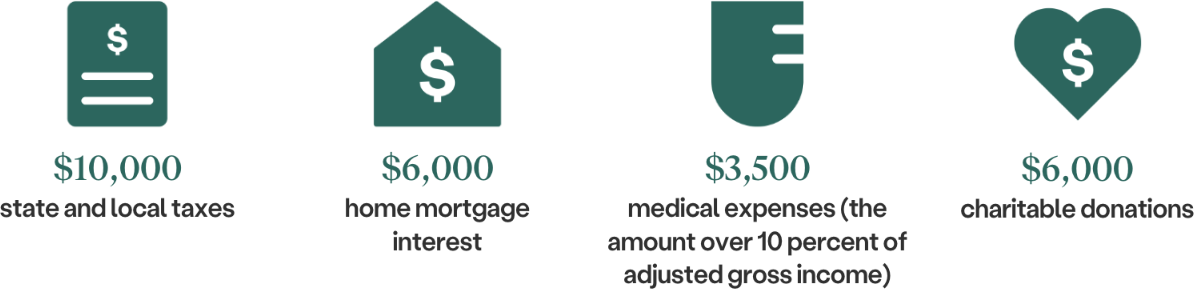
If the couple instead “bunches” two years of donations – $12,000 – in 2025 to a donor-advised fund (DAF), their total itemized deductions rise to $37,500. They itemize in 2025 and claim a larger deduction that year. In 2026, they take the standard deduction again, but still make grants to nonprofits from their DAF to maintain steady support.
A donor‑advised fund at San Diego Foundation lets you claim the full deduction in the year you contribute to the fund, then recommend grants to nonprofits on your own schedule.
4. Add a Planned Gift to Your Estate Plan
Did you know that giving back can last a lifetime and beyond?
Many SDF donors revisit their estate plans with their professional advisors during Q4, which often presents an opportunity to consider establishing a planned gift during the Giving Season.
SDF legacy funds provide lasting benefits for donors, families and causes that matter.
By setting up a legacy fund, you can direct the lasting change you want to make in our region and beyond. Legacy gifts come in all shapes and sizes – and from a variety of assets, including:
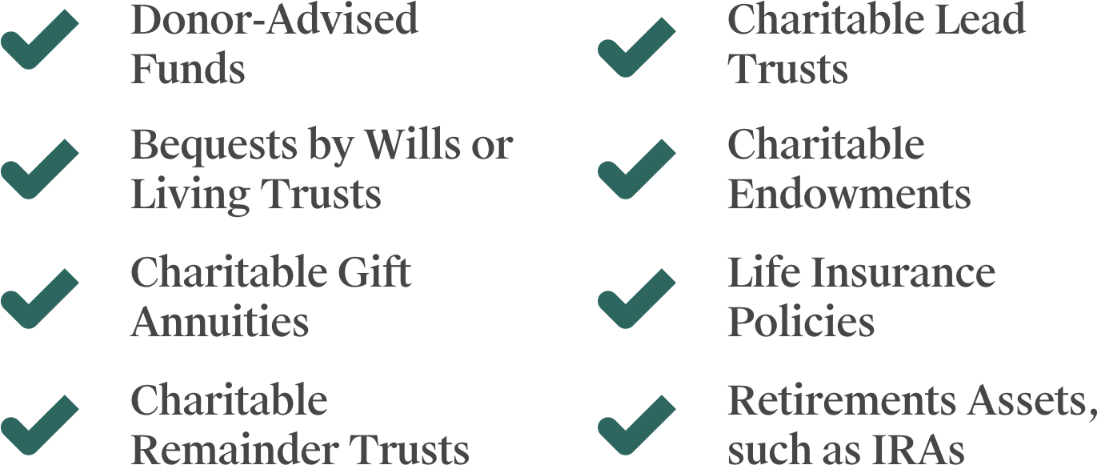
The best part? If you already have a DAF with us, you can simply amend your existing fund agreement and work with us to ensure your DAF is named in your estate plan as the gift you wish to make upon your passing.
5. Donate Complex Assets
In addition to publicly traded securities, SDF accepts gifts of complex assets, including real estate, business interests, privately-held stock and more.
We specialize in simplifying the process of converting complex assets into charitable contributions. We accept asset gifts that many other nonprofits and commercial brokerage firms do not have the ability or the experience to accommodate.
6. Make a Qualified Charitable Distribution (QCD) if you’re 70½+
Introduced in 2006, Qualified Charitable Distributions (QCDs) help offset the Required Minimum Distribution (RMD) income tax burden and encourage charitable giving.
The law allows a taxpayer age 70½ and up to donate up to $105,000 total to one or more charities or eligible initiatives directly from a taxable individual retirement account (IRA) instead of taking their RMD. Because RMDs typically count as ordinary income, they could push you into a higher income bracket, negatively impacting your retirement benefits and income taxes. Donors can also direct a one-time, $50,000 QCD to a charitable remainder trust or charitable gift annuity as part of the 2023 SECURE Act 2.0 legislation.
QCDs have become a popular way for donors to support causes they care about while offsetting RMD income taxes.
Although QCDs cannot be gifted to DAFs, you can gift QCDs to initiatives like United for San Diego, Fifty & Forward and more.
They provide many potential benefits and may be a suitable giving strategy if you:
7. Pair Tax-Loss Harvesting with a Cash Gift
In this market, you may have publicly traded securities that have declined in price below their cost basis (purchase price). If you sell those securities at a loss, capital losses can offset capital gains from better-performing securities and/or up to $3,000 of ordinary taxable income. This process is called tax-loss harvesting.
Donors who itemize their deductions can then claim a charitable deduction for donating cash from the sale proceeds. If capital losses are greater than capital gains and after reducing $3,000 of ordinary income, the net remaining loss may be carried forward to offset capital gains or ordinary income in future years.
8. Align Your Giving
As San Diego Foundation continues its 50th anniversary, consider aligning your giving with SDF donors through the Fifty & Forward Campaign, the most ambitious fundraising and grantmaking campaign in our history.
With your help, SDF will grant $500 million to realize our region’s greatest opportunities in three targeted areas: Education, Children and Families, and the Environment – and raise $1 billion to help shape our community’s future.
Or, meet urgent needs by donating to the Unity Fund in support of United for San Diego – a historic partnership among Prebys Foundation, Price Philanthropies, San Diego Foundation and the Price family to keep neighbors housed, fed and healthy amid unprecedented funding cuts to safety net programs.
2025 Year-End Deadlines
Review the critical dates below to ensure that your contributions and grant recommendations are received and processed by December 31, the IRS deadline for yearly tax deduction eligibility. For some assets, these dates fall in November.
- Mutual Funds – Donations must be received by November 24.
- Stock – Donations must arrive to SDF brokerage accounts by December 30 at Noon.
- Credit Card – Credit card donations can be made online before midnight December 31. Phone or in-person donations must be processed by December 31 at Noon.
- Wire or Electronic Bank Transfer – Funds must be received by December 31.
- Check – Checks must be postmarked on or before December 31 or hand delivered by December 31 at Noon.
- IRA* – Deadlines and actions needed are dependent on IRA contribution type and custodian.
*Includes Qualified Charitable Distributions (QCDs) and Required Minimum Distributions (RMDs)
Grants guaranteed to be postmarked before December 31 must be received by San Diego Foundation by December 18 at Noon.
Our team is here to help you maximize your giving and tax benefits during the 2025 Giving Window. Contact our Donor Services Team at (619) 814-1332 or [email protected] to discuss year-end giving with us.